performance text1
[New entry, 17 October 2023]
We met someone at the border.
They claimed they were a well-known sound artist who had just performed the most gruesome, unethical act on record.
They did not know whether they should turn themselves in, or exhibit at the next biennial.
It was windy, and our English was getting rusty.
We could not determine whether they had performed the act, or recorded it, or both.
They described the act in detail, then played us a recording.
The description was terrifying.
The recording was just noise.
It sounded identical to our music.
The sound artist fled the scene.
We did not know what we were in for.
For a while now, we had avoided listening with the ears.
We were approaching sound signals with extra caution and care, always asking for permission before close contact.
At first, we were using our fingers, or the soles of our feet to experience the vibration; but gradually, this created a sense of profound saturation, and eventually resulted in addiction.
We decided to handle the situation drastically, by inaugurating the first ever intensive workshops of the Initiative for the Emancipation from Vibration and Bass Frequencies.
In those workshops, we were interrogating our perceptual limits, employing our eyelids, or the fine hair on the back of the forearms as temporary interfaces.
We categorically denied the ease of visuality and gesture, persisting for hours on each attempt. To cultivate the untapped skills of our minutest, invisible limbs, at the very edges of our physical bodies, required us to remain stationary, carefully disciplining any survival instinct that urged us to move.
Soon, some began to express strong criticism against the initiative. They argued that our methods were hostile to a range of neurodiverse needs. At the same time, due to our funding sources, we were accused of sound-washing institutional totalitarianism.
The issue escalated quickly. Numerous abusive comments from unidentified accounts began to appear under all of our posts, threatening to cancel the initiative. The only solution was our complete and indefinite withdrawal from the online sphere.
We found our safe space in a damp, underground cave. Its echo held great promise: we hypothesized it could listen to us more profoundly than we could ever listen to our environment.
In total absence of daylight, our sleep lasted for longer and longer intervals. We identified the circularity of our circadian rhythms only in the most basic of functions, counting the bottles of water emptied by drinking, and filled by urinating. We took to documenting this emergent methodology, exploring its potential to act as a toolkit for new working knowledge. The cave had its own dark history that resonated deeply with our own traumas. While there, we made sure to keep ourselves busy, so as never to allow them to be uncovered.
Eventually, we ran out of bottles and had to terminate our residency. We were relieved to complete the project having reached the last milestone, with our deliverables adequately bottled. However, the sudden contact with unfiltered light and electromagnetic frequencies emitted by the a/c and smart apartments at close distance resulted in our total meltdown. We were diagnosed with scoliosis, ataxia and acute psychogenic analogue nostalgia, and had no option left but to enrol on a bespoke multi-year program for digital prospect restoration, and continuing rehabilitation from our embodied past.
This was how we met with the Microphone.
Our first contact was quite intrusive, bordering on harassment.
The Microphone stood in the space as if it had always been there, acting like an elephant in the room.
It was supposedly listening. But this felt nothing like the cave and its boundless, selfless embrace. Every time we approached it, it resisted any form of cooperation, putting up an impermeable wall between the voice and its sound.
The subtle resonances of each oral cavity, the reflections across different lips and dentitions, the infinitesimal vibrations that connected each unique inner sound to a different outside world, were of no interest whatsoever to the Microphone.
The Microphone made clear that it only recognized telephonic speech. Its sole purpose was to compensate for missing images. To demonstrate, it invited us to approach it with anything that could be seen but not heard clearly, in order for it to be rendered audible. By intimating our most apocryphal, epiphonetic fragments to the Microphone, we automatically experienced sensory responses in previously unknown meridians. We felt like the protagonists in our very own Narcissus myth, getting closer and closer, until we almost drowned in feedback.
This was the technique that would allow us to escape, by distracting the Microphone that had discovered itself for the first time.
Having understood the dangers of our sonic adventures, we dedicated ourselves fully to the exploration of gaps between words. We substituted our recording devices with keyboards and monitor screens and delved tirelessly into every form of code. For a while, this pursuit brought us unprecedented joy. In the mornings we critiqued everyday life, dancing deftly between ideological entanglements and solidly entrenched meanings. In the evenings, like other object-oriented Frankensteins, we prompt-whispered artificial intelligence into secret tricks for combinatorial creativity, challenging it to fulfil all of our desires for derivatives.
It was a one-way street. An impasse closing in on our re-encounter with the Microphone. This time, we didn’t even have to go near it. It had already recorded us. With the help of the screen, everything we had thought inaudible had been graphically rendered, re-packaged, archived and sold to the new logo-philic market. Our moments of awkwardness, our meagre attempts to escape, had all been captured and reduced to flashing green ciphers on a black background.
The Microphone was now the world. Reality was witnessed through the fidelity of its reconstruction.
I don’t know how much time passed in that darkness. I realized I was here when I heard my voice narrating.
Her tone was vaguely familiar yet uncanny. The consonants sounded eerily perfect. The vowels all seemed to have roughly the same duration of attack, sustain, decay and release. But no matter how many times I recorded the exact duration to verify this impression, the numbers kept betraying me. And besides, I did not know whom I was supposed to prove this to.
Now I am finally talking with my own voice.
Our conversations, frugal but resourceful, sound a bit like this:
Μe: Are you listening to me?
Voice: I am listening
Me: Can you listen with me?
Voice: Ι am listening
Μe: Who are you?
Voice: I am listening
Me: […]
sources (revisited)2
Cicadas, passing aeroplanes and bees. Walking around the hillside property while an interview is being recorded. Apano Meria, Syros, Greece (June 2021).
Fingers touching wild thorns during nearby interview recording. Prickly listening. Apano Meria, Syros, Greece (June 2021).
Old wooden winch with no bucket, hanging over half empty family house cistern. Ano Syros, Greece (August 2020).
Epitaph procession bells and distant sheep bleats between Ano Syros and Vrontado. Startled cat approaching the recording device without being captured. Ano Syros, Greece (April 2023).
Footsteps on debris and collapsed building materials, inside the abandoned Gyaros prison. Gyaros, Greece (June 2021).
Gentle knocks on metal. Coaxing resonance from the center of ‘Rogmi’ (‘Fracture’) art monument to the political prisoners. Gyaros, Greece (June 2021).
Recorder noise. Capturing the tension during hasty boarding of departure boat. Gyaros, Greece (June 2021).
Boat engine noise. Barely discernible discussions in English between boat captain and research team. On the way back from Gyaros. Near Kini, Syros, Greece (June 2021).
Digital interference from Globus radar. Hesitant encounter with the certainty of mechanical observation. Vardo, Norway (September 2021).
Footsteps on pebbles, Ultima Thule cave entrance. Tiptoeing on the gates to the underworld. Domen, Norway (September 2021).
Wind shaking coloured plastic sheets at the Domen Viewpoint observatory overlooking Vardo. Listening for hues and vibrations. Domen, Norway (September 2021).
Wind and passing cars recorded off road near path to Domen Mountain. Domen, Norway (September 2021).
Close miked rocks collected in Vardo, Norway. Partially covered in live moss and fungi. Appearance and sound variable over time. Athens, Greece (April 2023).
Piano improvisation by Danae. Investigation for a possible performance. Athens, Greece (April 2023).
Close miked humming by Ioannis. Investigation for a possible sound installation. Athens, Greece (April 2022).
Percussive sounds inside the home piano. Investigation for a possible sound installation. Athens, Greece (April 2022).
Distorted failing tape loop, intermittently losing touch with tape heads. Investigation for a possible sound installation. Athens, Greece (April 2022).
Assortment of home recordings made during the Covid-19 lockdowns for projects duly submitted and yet to be released (March 2020 – April 2022)
A silent reading of Pamela Lu’s Ambient Parking Lot on the intercity train Athens to Thessaloniki, Greece (January 2022).
Invisible parrot across the street, mimicking long obsolete mobile phone ringtone. Athens, Greece (June 2023).
This is an Open Access article, distributed under the terms of the Creative Commons Attribution licence CC BY-NC-SA 4.0
-
1.
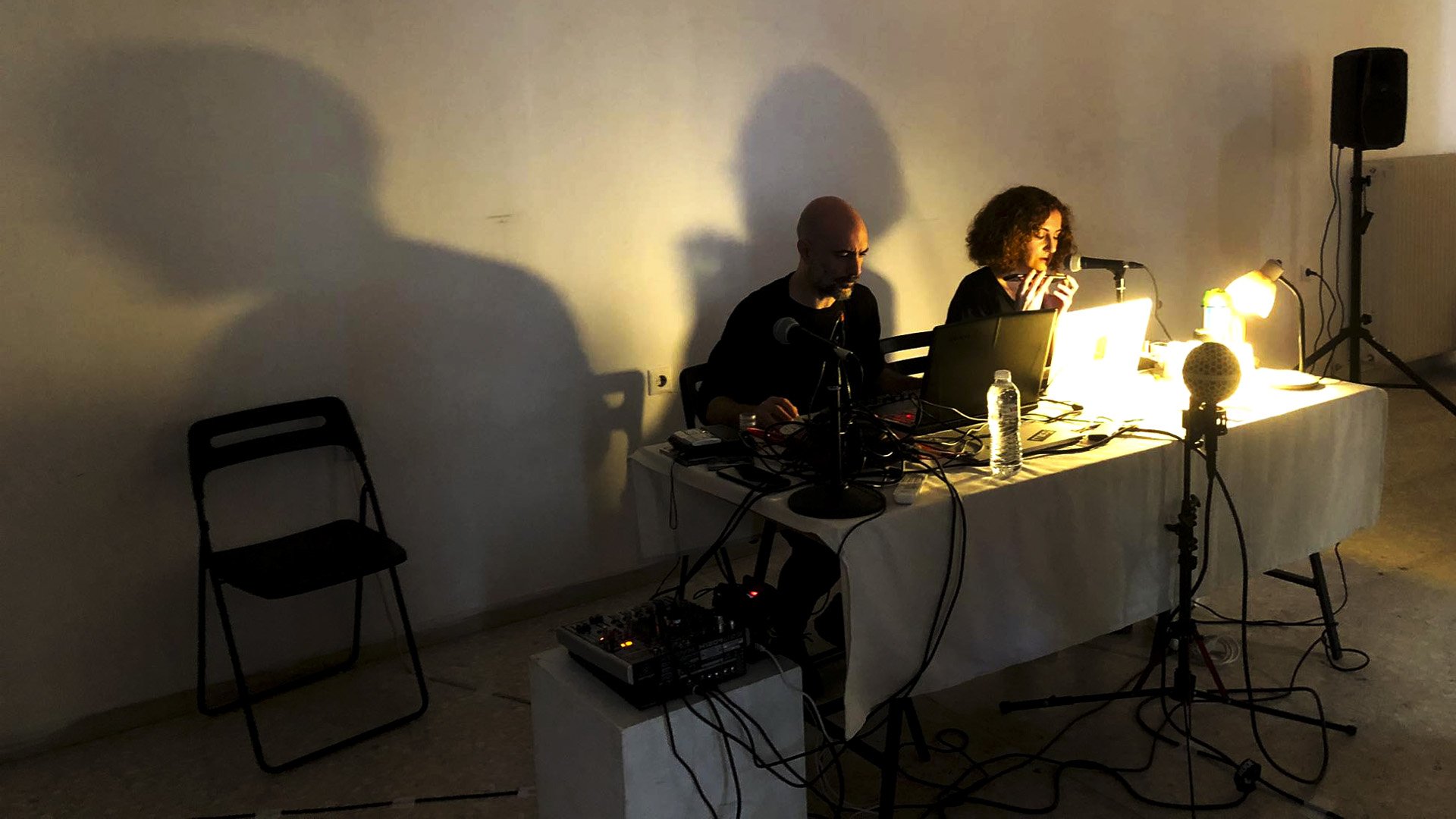
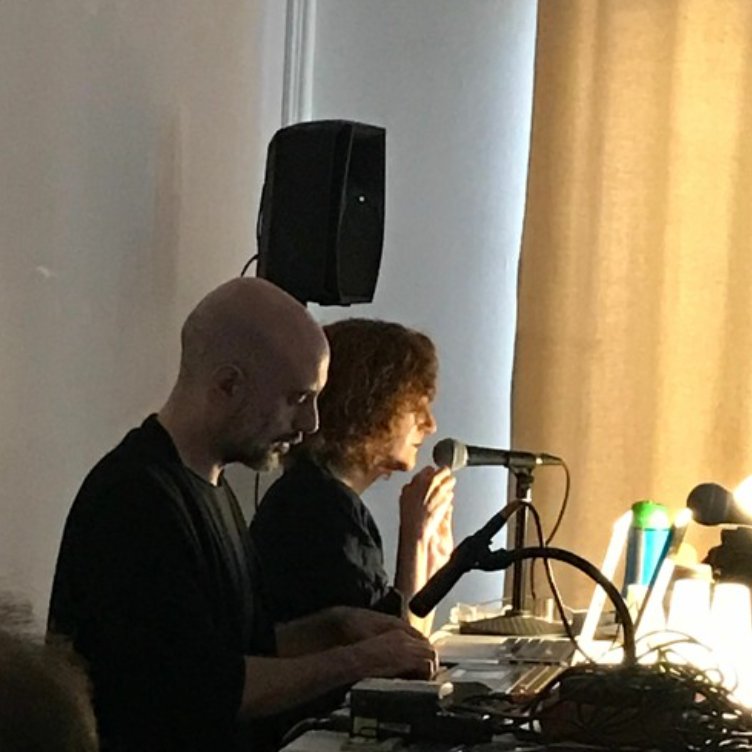
The text is part of the failed recording performance by acte vide (Danae Stefanou & Ioannis Kotsonis) and can be followed along while listening to the audio recording. It was written and performed by Danae Stefanou, as part of a half-hour live performance-lecture by acte vide. The current version of the text was presented in English at the Listening as Witnessing Symposium that took place in Athens on 17 October 2023. The audio piece accompanying the text for this issue of Witnessing is a recording of that live performance.
A first version of the text was presented in Greek in April 2023 (No Ordinary Festival, Prelab, Athens), and a second, slightly modified iteration in September 2023 (Stereoma Festival, MOMus – Experimental Center for the Arts, Thessaloniki). The introductory ‘diary entry’ segment changes with every iteration. -
2.
The ‘Sources’ section was jointly compiled by both members of acte vide (Ioannis Kotsonis and Danae Stefanou) after a series of reflective listening sessions carried out between 2024 and 2025, also taking on board feedback received during the Hydra Residency/Workshop ‘Audio Paper Creative and Artistic Practices’ organized by the ERC-MUTE (August 2024). The section can be consulted as a stand-alone companion to the failed recording text and audio. It can also be read as an alternative to the traditional References section usually found at the end of an article, allowing readers to situate the text and audio physically and emotionally, rather than bibliographically.
The list is not exhaustive, and the order does not follow the sequence of sonic events in the audio piece. In keeping with our diffractive and elliptical approach to documentation, we note that while our work is fictional, our sources cannot be anything but real.
failed recording performance, Symposium Listening as Witnessing, 17 October 2023
Photo credit: Eva Matsigkou
Focusing on unexpected, unwarranted or undocumented encounters between listening and recording devices in the field, failed recording is a sound and text performance by research-creation unit acte vide (Danae Stefanou & Ioannis Kotsonis). The performance intertwined a fictional first-person narrative account with original field and home recordings, silent artefacts, and sound-producing objects gathered during fieldwork which we still find hard to present in a discursive manner. By conjuring an eerie, uneasy space between autoethnography, overidentification, irony and fiction, the performance considered witnessing as a resistant act of masking and self-silencing, to explore tacit questions of positionality, epistemic bias and symbolic violence in the domain of listening.
Keywords: sonic fiction, performance writing, field recording, autoethnography, overidentification, listening, sound studies
acte vide is the duo project of Ioannis Kotsonis and Danae Stefanou. Active since 2006 as an experimental & improvisatory unit, they dwell at the interstices of noise and silence in ever-changing, real-time formations, which often resist or creatively undermine documentation. The duo have created performances and installations in international and regional festivals and exhibitions (Borderline, Irtijal, Documenta, Athens Festival, TIFF and many others), as well as in DIY contexts. They have also composed live soundtracks and original sound design for a range of films, from early classics like Battleship Potemkin (Goethe Institut Athen 2016) to contemporary experimental shorts like Itys, Praxithea and Me (dir. Prokne, 2022). Their joint activity extends towards a broader range of artistic research and critical practices, through the design and realization of original curatorial and educational interventions, including the Knot Gallery sonic improvisation workshops (Athens, 2009-2014) and Sound Meetings initiative (Syros 2012–2022).
Danae Stefanou is Professor of Musicology and Sound Studies at the School of Music Studies, Aristotle University of Thessaloniki (AUTH). Her work is situated at the intersection of musicology, sound studies and critical practices, with a special focus on experimental and improvised music, speculative listening and intermedia artistic research. She has led artistic research & training programs for a variety of EU projects and networks including COINVENT, Interfaces, Sounds Now, Transmissions and Music4Change, and has contributed chapters to peer reviewed volumes, including the Cambridge Companion to Film Music (CUP, 2016), Made in Greece: Studies in Greek Popular Music (Routledge, 2018), Contemporary Popular Music Studies (Springer, 2019), Music and Landscape / Soundscape and Sonic Arts (Universal Edition, 2019) and Perspectives on Greek Musical Modernism (Routledge, 2025), as well as authoring entries on Greek musicians for Grove Music Online. She has also co-edited a special issue on Creative Conceptual Blending for Musicae Scientiae (2018) and two collections of text and graphic scores resulting from participatory improvisation and interdisciplinary co-creation workshops (Multimodal Community Scorebook, 2022 and A Sound Sketchbook, 2025). Active as a performer since the 1990s and a founding member of Athens-based research-creation unit acte vide since 2006, she is the founder and director of σ.π.Α.Μ.* Experimental and Improvised Music Ensembles and has performed, composed and devised hundreds of independent actions and interventions in public spaces, DIY venues, arts institutions and educational establishments.
Ioannis Kotsonis is a sound artist and musician based in Athens. He has composed electronic music for theatre, dance, multimedia installations, and film. He gives concerts on a regular basis, often in collaboration with other artists, and is a founding member of Athens-based research-creation unit acte vide. Yannis has released seven solo albums and has contributed to several compilations. Since 2009 he has been active as an independent workshop, residency, and concert coordinator (Syros Sound Meetings, KNOTmusic, minor act). He has taught undergraduate and postgraduate courses in Media Studies, Film and Philosophy, and Sound Design at the University of Wales Swansea and the University of Piraeus in Greece where he currently teaches at the Digital Cultures postgraduate program, and has organized and facilitated DIY electronics and sound art workshops for schools and local community groups around Athens in the context of ‘Interfaces’ and ‘Sounds Now’ (Creative Europe – Onassis Foundation). Ioannis has worked as artistic research associate at the ERC CoG project ‘Soundscapes of Trauma: Music, Sound, and the Ethics of Witnessing’ (National Hellenic Research Foundation). He produces and hosts the ‘Resonator’ radio show (for Concertzender radio) and ‘Sound Unfolds’ (for movement.radio) and co-hosts ‘Proschedio’, a weekly Athens-based underground and experimental music internet radio show since 2014.
Stefanou, D. and Kotsonis, I. (2025) ‘Failed Recording: A Sonic Fiction’, Witnessing, 1. Available at: https://doi.org/10.26238/witnessing.2025.01.11