The Melissa Network of Migrant Women, located in Victoria Square in the center of Athens, is a community space that provides support, education, and creative opportunities for women from diverse backgrounds. From July 2023 to January 2024, Nelli Kampouri, Ioannis Kotsonis, and myself collaborated with Melissa in the context of ERC MUTE in order to realize and facilitate two cycles of workshops focusing on sound and music, as ways to share experiences and listen to one another. The participants, who wish to remain anonymous, came together in these sessions to explore listening and storytelling through sound. Once we obtained their informed consent, our group meetings were recorded. After a collaborative editing process, extracts from these recordings became a series of podcasts, which were aired on the ERC MUTE YouTube Channel in June 2025.
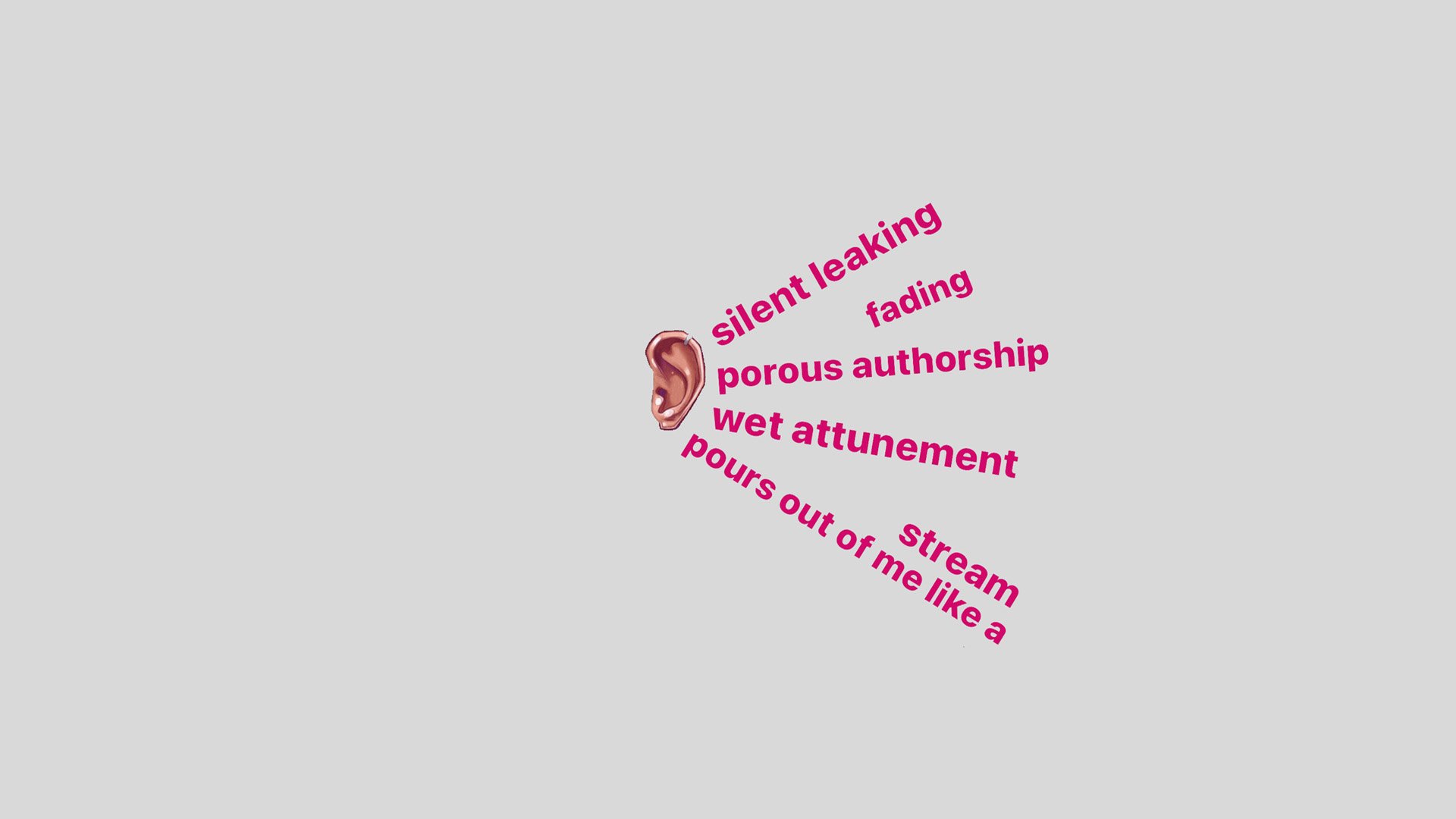
silent leaking
When we began visiting Melissa for the workshops, I was struggling to overcome a depressive episode. The flow of everyday life in Melissa and the way the space felt like a refuge kept me grounded and away from a state of instability and chaos while I was there. It was a small victory to be able to do at least that part of my work.
Now, I find myself at another crucial moment for my mental health, and the only thing that comes organically to me is to immerse myself in the completion of this text that is related to that project. Perhaps, subconsciously, I am trying to restore the bodily state of being among other women for whom uncertainty and resilience are an integral part of everyday life (Biehl, Ghodsee, and Stevenson 2020, p. 15; Kambouri, 2013).
I usually arrived just before we were scheduled to start, allowing myself a moment to settle in. There was always a place to sit, and if not, others would quickly make room. No one there was pretending not to see you; they acknowledged you with a smile. Coffee, tea and comfort food were always available for everyone. I would sit quietly, absorbing the atmosphere, and engage in a ‘slow’, ‘out of fashion’ listening, to feel what was happening around me and let myself be absorbed by it. Αs Grehan (2019) puts it, ‘slow’ and ‘out of fashion’ listening is a practice that requires the listener to pause, pay close attention to the mode of address, scene, gesture, tone, language, and broader political or social context. It is an act of being fully attuned to the speaker, making room for a range of responses including deep understanding, partial acceptance, dissonance, disagreement, and misunderstanding. This type of listening resists dominant modes of surface absorption, aiming instead for a profound attunement before responding. It is a political act of resistance against the rapid and superficial flow of everyday communication, crucial for acknowledging and accepting differences, and considering the ethics of attunement.
Melissa is a space of being with, and being with is one of the most important forms of care and listening (Biehl, Ghodsee, and Stevenson 2020, p. 31; Voegelin, 2023). It’s a familiar place, a place that is comfortable and comforting, and is often the in-between space, the interval (Ahmed, 1999, p. 330). Listening is crucial there. You need to listen attentively to understand (yours or other peoples) individual needs, considering cultural, sociopolitical, and practical aspects (LaBelle, 2018; Sterne, 2012). You need to listen to provide care, assistance, guidance. To mediate with the gynecologist, the lawyer, and public services. To foster connections through grief and pain, support and empowerment, solidarity and friendship, motherhood, couple and family issues, and so many more aspects of life.
I would admit now, as I am always intrigued by how theory can sometimes feel distant from practice, that at Melissa, my theoretical understanding of certain listening practices started to gain flesh and substance.
porous authorship
These varied positionalities between proximity and distance actually created an open space for listening, a space that we might also consider a third space, not yet saturated by already completed and legitimized narratives. Further, this space allowed new stories to emerge. To me, following a ‘shared authority’ ethos was simply about recognizing the narrators as the sole authority of their narrative, the authors of their stories. (Martelly 2018, p. 187)
We gradually gathered in the room where we held the workshop and sat around a large table. Sometimes, someone brought their baby or young child along. We would place the recording device on the table. Participants were assured that their agency would be preserved; they were protected by the consent forms they signed, and no faces would be shown. They had the option to request the erasure of parts of the recordings. But there was also something else. The device on the table did set boundaries symbolically. Its presence gave the impression that it had the power to capture everything, but it also served as a sonic safety net, reminding participants they could protect themselves and their stories from being recorded. It created an interesting combination of the notions of self-censorship and awareness. An off the record space popped up in the sonic sphere. What would be captured in this device? What might be audible in the recordings?
[●ʀᴇᴄ]
A group of women discussing and listening to each other, making room for everyone’s voice to be heard. Multiple stories that existed before that moment and others that were formed through shared authorship between the group (Martelly, 2018). Very important and intimate personal details, testimonies, and life experiences. Snippets of environmental noise, a multitude of languages and dialects, and some beautiful singing. What might be inaudible are the light steps of the Queen Bee cat walking around the room, tears leaking, mouths hesitating in speech, eyes flashing with frustration, hands caressing other hands.
Voices, names, and languages spoken are integral parts of social and political identities. The tone set, the stories and how they were told, were shaped by the moment and the circumstances, and by who was listening. It matters that apart from us being there, women refugees shared their stories in a group setting with other women refugees from various countries, and that they hosted us in the familiar and intimate environment they inhabit (Gardner, 2023; Haraway, 2019).
pours out of me like a stream
‘I am sorry for talking so much. It's traumatic and hard to talk about, but it pours out of me like a stream, beyond my control. How do you feel when you hear these things?’ 1
As refugees and displaced people, the participants face daily issues critical to their own survival, and they often feel compelled to adjust their way of speaking depending on who is listening and what is at stake. However, in many other contexts, they lack the necessary accessibility, and they are struggling for vocal space (Srigley, Zembrzycki, and Iacovetta, 2018; Tiffe and Hoffmann, 2017).
Podcasting allows women and other minorities access to broadcast media but with far fewer restrictions. For one, there are no norms regarding how to speak. In general, the more you sound like yourself the better. (Tiffe and Hoffmann, 2017)
In the case of this podcasting workshop their stories were recorded and would be made public. It’s quite possible that the dynamics of storytelling changed when they realized that their listeners would not be limited to those in the room (Srigley, Zembrzycki, and Iacovetta, 2018). Finding the words to speak into the recorder isn't trivial (Biehl, Ghodsee, and Stevenson, 2020).
During the editing phase, while assisting with the technical aspects of sound editing, I reached another critical point in the process, grappling with the delicate matter of handling voices and stories of others. Choosing podcasting as the medium for publishing the recorded stories provided the time and necessary distance for careful editing in collaboration with the participants, allowing us to collectively decide what would be shared and to apply a filter of ethical considerations to the content.
The recordings were grouped, edited and creatively mixed to reflect the topics discussed. We invited participants to provide radio-oriented aesthetic guidance to capture the atmosphere they wished to convey as narrators. The final productions do not conform to the typical podcast format. Instead, we hacked the popular process to effectively capture the essence of our workshop period at Melissa.
Sounds certainly move, but they also transgress, bundle, vibrate, filter, shatter, and penetrate; they may form into powerful cultural objects, recorded, sampled, cut ’n’ mixed according to a project of errant subjects. (LaBelle, 2018, p. 109)
Despite being pre-recorded, podcasting maintains a sense of liveliness, creating a sense of proximity and co-presence between the audience and the content creators (Euritt, 2022). It is important to note that we were documenting a particular moment in history, marked by politics, wars, migration, current life events, and hardship.
wet attunement
Listening requires suspending your own sense of what the world is like or how it should work, because you have those notions all the time, you carry them with you. (Biehl, Ghodsee, and Stevenson, 2020, p. 58)
When we move about the world as if it were always there. (Lipari, 2014, p. 220)
Struggling with numerous ethical issues and questions of positionality (Loose and Starecheski, 2018; Papaeti and Grant, 2024) and being aware of both the obvious and subtle differences and similarities we shared, I will attempt to describe my thoughts by imagining myself as a different kind of a recording device. A bit sad and tearful.
‘How am I to listen to you?’ Here I draw on McCartney’s (2016) use of Irigaray’s phrase to define a mode of listening that is both personal and highly responsive, deeply attentive, and open to the unexpected. This approach emphasizes engaging actively with the unique and evolving aspects of the other, aiming to foster spontaneity and creativity rather than seeking predetermined understanding or control.
What I am trying to express has layers of what I remember hearing in the way I heard it; the recordings I listened to repeatedly to edit the podcasts; the replay of all those memories in my head. My story is based on impressions, questions and reflections, remnants, gaps and silences and things that are imprinted through an improvised listening (McCartney, 2016; Stefanou, 2015) and cannot be recorded by a technological device. My recording is affected differently by the lo-fi and hi-fi2 sonic elements (Schaeffer, 1994, p. 43). When clarity is lost into overlapping noises, overwhelming presence and auditory chaos, then it is my turn to appear.
Considering my colleague’s concern based on her extensive experience that many projects and programs wish to teach refugees, I wonder what I have learned through this entire process, as I still have the hum in my ears. Pretending to be a human(ish) recording device can stimulate creative engagement with ethical issues and questions of positionality, but it does not make these issues, or you, disappear. Instead, you can experiment with alternative listening modes of existence that circulate among you and others, navigating these complexities by shifting from positions of knowing and judging to ones of learning and appreciating (Borland, 2018, p. 35).
At this point, listening makes more sense as a step into research (Gardner, 2023) and what I did learn is to keep an open heart to diverse ways of learning, ways of decolonizing my feminist perspective (Haraway, 2019, p. 62), and embracing theory production that emerges from the indeterminacy of stories that are not yet heard.
Knowledge may be passed on by absorption, experience, and deep listening rather than through a western notion of pedagogy, which associates learning from stories with a fictional or non-fictional plot separated into beginning, middle, and end. (Anderson, Hamilton, and Barker, 2018, p. 175)
As I write the final words of this essay, I’m still dealing with low levels of stability and resilience. I feel like a low-battery recorder. A bit worn out and weak. I am as weak as sound can be (LaBelle, 2018). And if the research material I am referring to is seen as a sound object, then my recording is ephemeral, fleeting, fragmented and constantly changing. Yet, the hum recorded through my ears places me comfortably in a space of communal care and comfort.
Weakness is put forward as a position of strength; a feature whose qualities enable us to slow down and attune to vulnerable figures and the precariousness defining the human condition. Sound teaches us how to be weak, and how to use weakness as a position of strength. (LaBelle, 2018, p. 20)
fading (is not the same as cutting)
According to Lipari (2014), attunement can be understood through two ancient Greek concepts: kairos and akroasis. Together, they describe a form of listening that transcends linear time and binary oppositions. Kairos represents a nondual, synchronous engagement with the present moment, while akroasis adds depth through its focus on deep, esoteric listening. Combining these concepts, attunement becomes an ethical and embodied process, integrating the timing of kairos with the depth of akroasis.
There are many ways of listening – to oneself, to others, to their stories and testimonies – that are proposed in this essay: attunement (Lipari, 2014), ‘third space’ listening (Martelly, 2018, p. 187), ‘slow’, ‘out of fashion’ listening (Grehan, 2019), listening as a form of care (Biehl, Ghodsee, and Stevenson, 2020, p. 31; Voegelin, 2023), unbiased listening (Biehl, Ghodsee, and Stevenson, 2020, p. 58), situated listening (Ahmed, 1999; Haraway, 2019), improvised listening (McCartney, 2016; Stefanou, 2015). I realize that they all require a certain criticality in relation to time and knowledge. They involve slowing down, and they could be helpful to avoid the rush and hush imposed by epistemic violence which oppresses entire genealogies of human and non-human subjects in and through the domain of knowledge (Stefanou, 2023).
As I see it, this study has helped me to put my fragmented thoughts and feelings into a narrative and references to other people’s stories or studies have helped me make the connections that hold it together. In my mind, it parallels the artistic process of sound composition: moments that have already happened, but also something new that I want to express, which is both creative and healing for me. I owe it to the inspiration I gained from the time I spent at Melissa with my colleagues and the women I met there.
Instead of rejecting the poetics of theory, let's ask how, when, with whom, and from where we create theory, texts, and art as exercises in slowing down and wandering for knowledge and readings that happen differently and elsewhere, already and not yet. Let us take this time, despite the capitalist ‘knowledge economy’ that demands rapid satisfaction. A logic that is hostile to the democratic and non-commercial production and distribution of knowledge and art. (Athanasiou, 2020, p. 100; my translation)