Listening to Aphonic Borderscapes in Western Thrace: A Self Reflective Audio Essay
Transcript
[INTERVIEW RECORDING: Ashraf, Ramallah, 2020]
This is what Ashraf was telling me some years ago reflecting on the border in Palestine.
[SOUNDSCAPE RECORDING: Underwater ambience, Evros Delta]
A few years later, I found myself listening and recording at the border of the European Union – the Greek borderland with Turkey and Bulgaria, in Western Thrace and in Evros. The geographies are different, but the politics of listening resonate across them.
Borders are never only lines on a map. They are porous, fluctuating, and contested territories acoustic, social and geographic ones: expanding and shrinking over time, traversed by bodies, carrying stories of oppression, surveillance, and desertification.
I arrive here not as a neutral figure, but as a Greek from Athens, living in Germany. This matters. It allows me to present an ID, to explain myself as an artist or a researcher. I am permitted to listen. For others, listening here would be impossible, even dangerous.
Listening is never neutral. It is shaped by positionality, by who listens and under what conditions. And even more, a recording is not an innocent act: it is always situated, always embedded in power. At the border, even the decision to record – or not to record – is already political.
Listening at the border is not passive. It can be a way of knowing, a way of witnessing. But it can also be an act of control.
In my research, I use listening as a methodology to approach this borderland – In this audio paper I will focus on the area around the forest of Dadia.
This is the frame of the soundscapes I will unfold here, and the silences they reveal.
[SOUNDSCAPE RECORDING: Dadia Forest, Winter 2025]
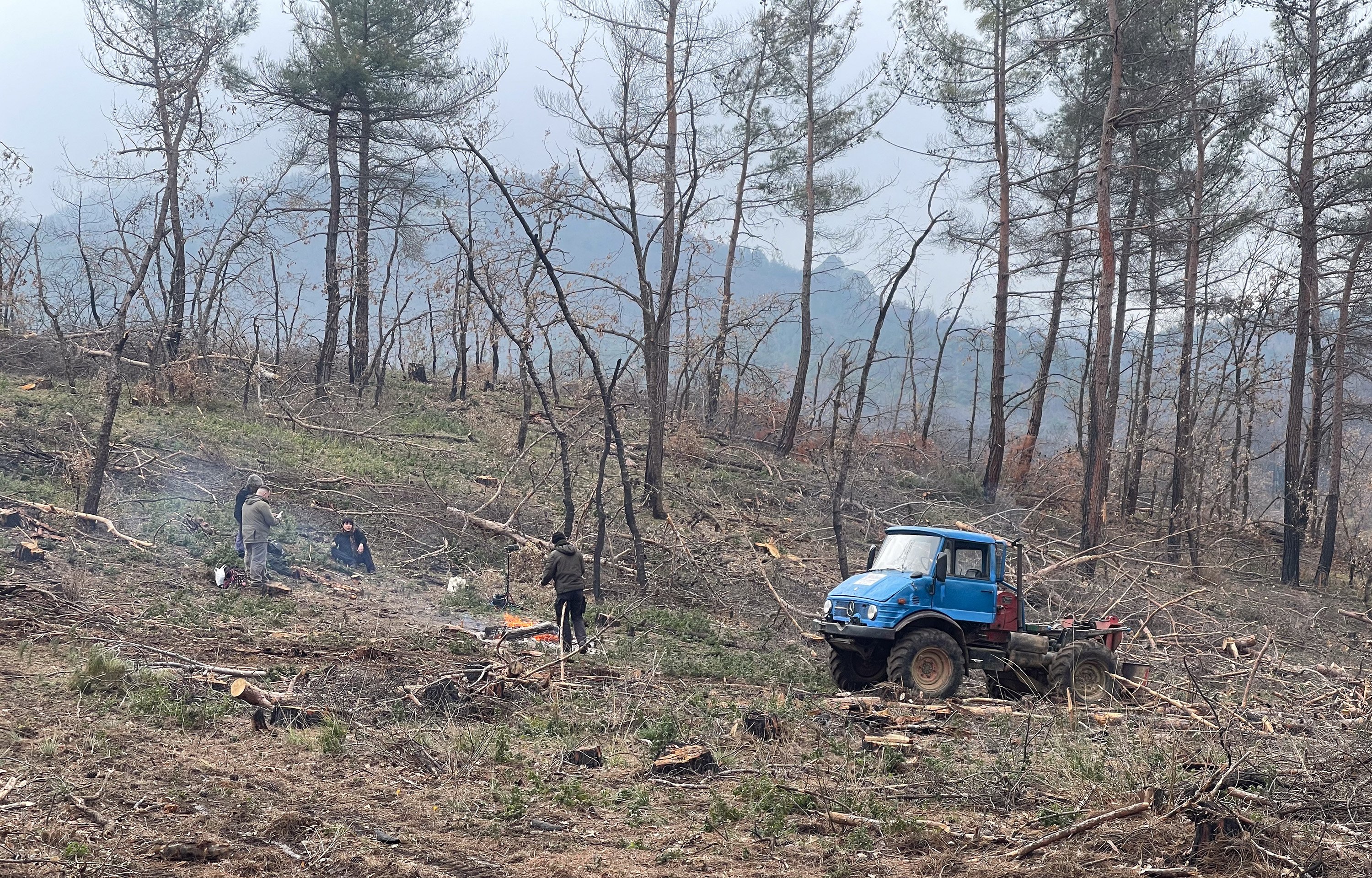
Dadia, or more precisely the Dadia–Lefkimi–Soufli Forest National Park, lies in northeastern Greece, where the country meets both Turkey and Bulgaria. It is an ecologically significant forest, home to all four native European vulture species, and shaped not only by pine and oak but also by checkpoints, leftover belongings, military patrols, and the silent traces of those who traverse it unseen.
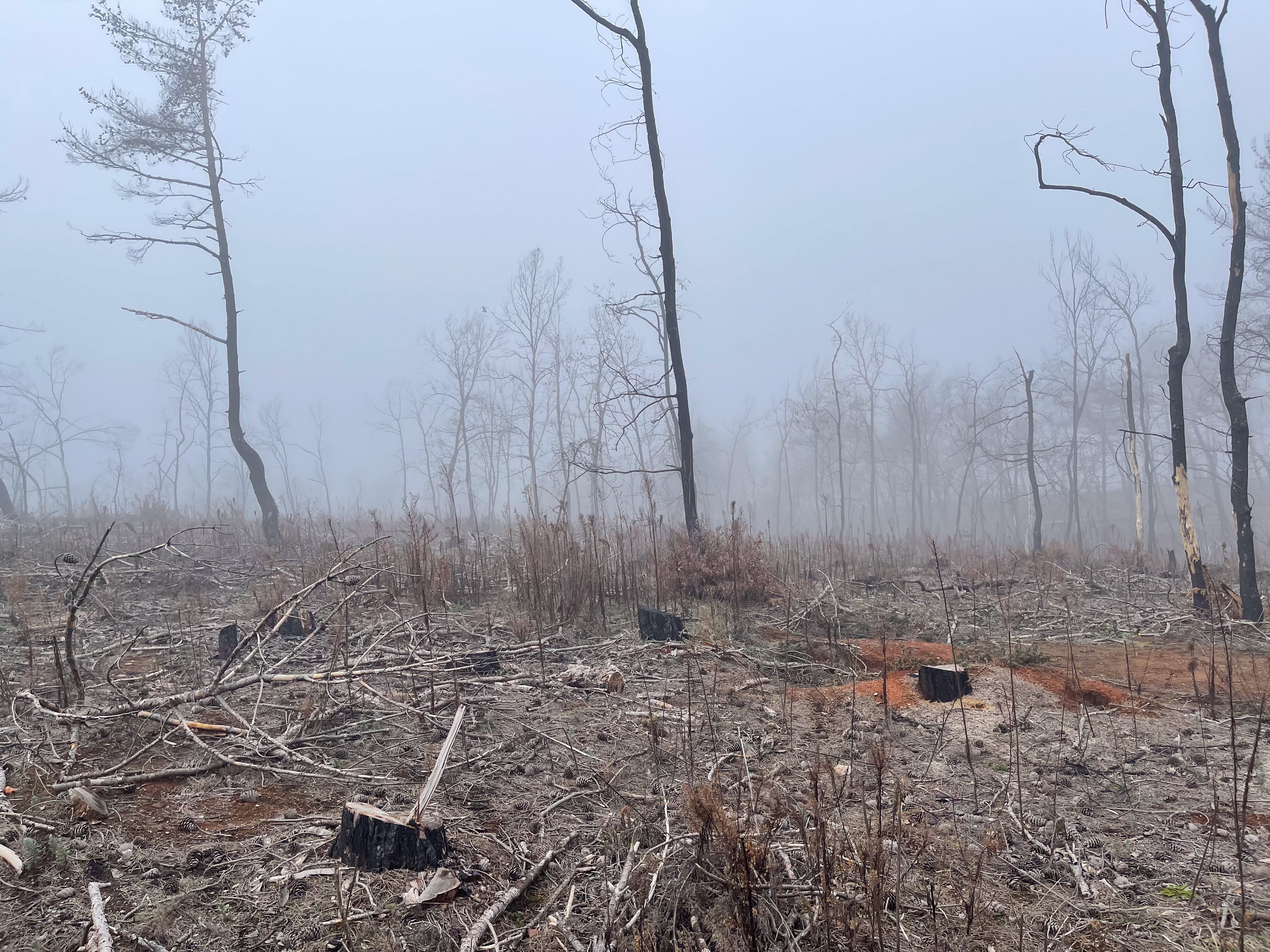
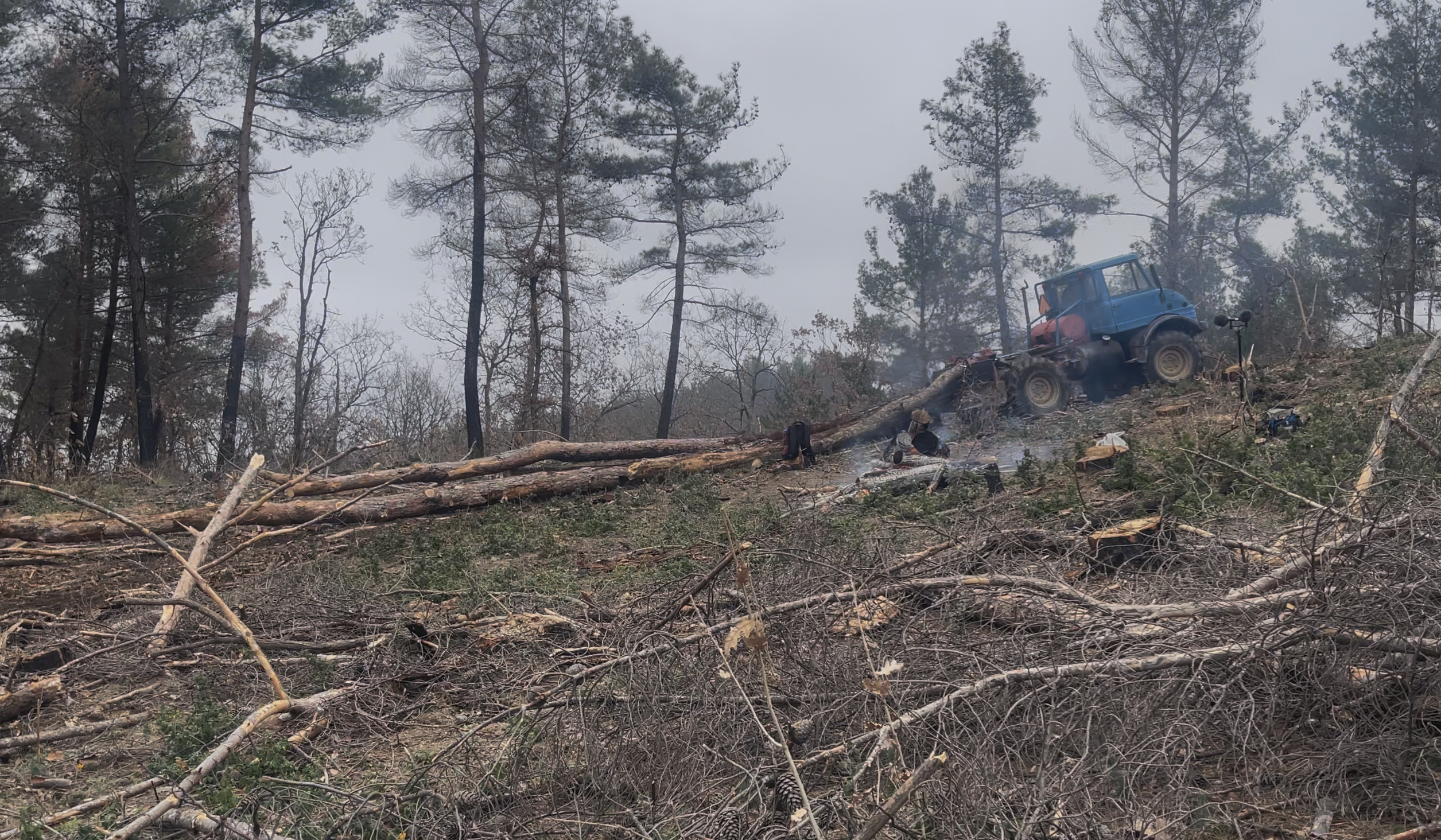
The wildfires of 2022 and 2023, and the horrific event of at least nineteen people according to the official numbers who were trapped and died here while trying to cross, profoundly altered the environment. Left behind long stretches of silence, broken only by wind through burned branches or the distant echo of life outside the forest.
The first impression of my recordings was an uncanny, eerie silence where the noise floor of the mics was so loud in order for anything else to be able to be heard. This silence was sometimes broken by the repetitive sound of planes flying to Istanbul. In some areas, nothing sounded for twenty-four hours. A silence that felt both ecological and political – the desertification of the forest, and the absence of those who were before sheltered by it.
With special permission from the ministry, I was able to traverse parts of the forest together with the artist and researcher Vasilia Georgiou.
Only then I did encounter shepherds and loggers from minority villages, cleaning the forest.
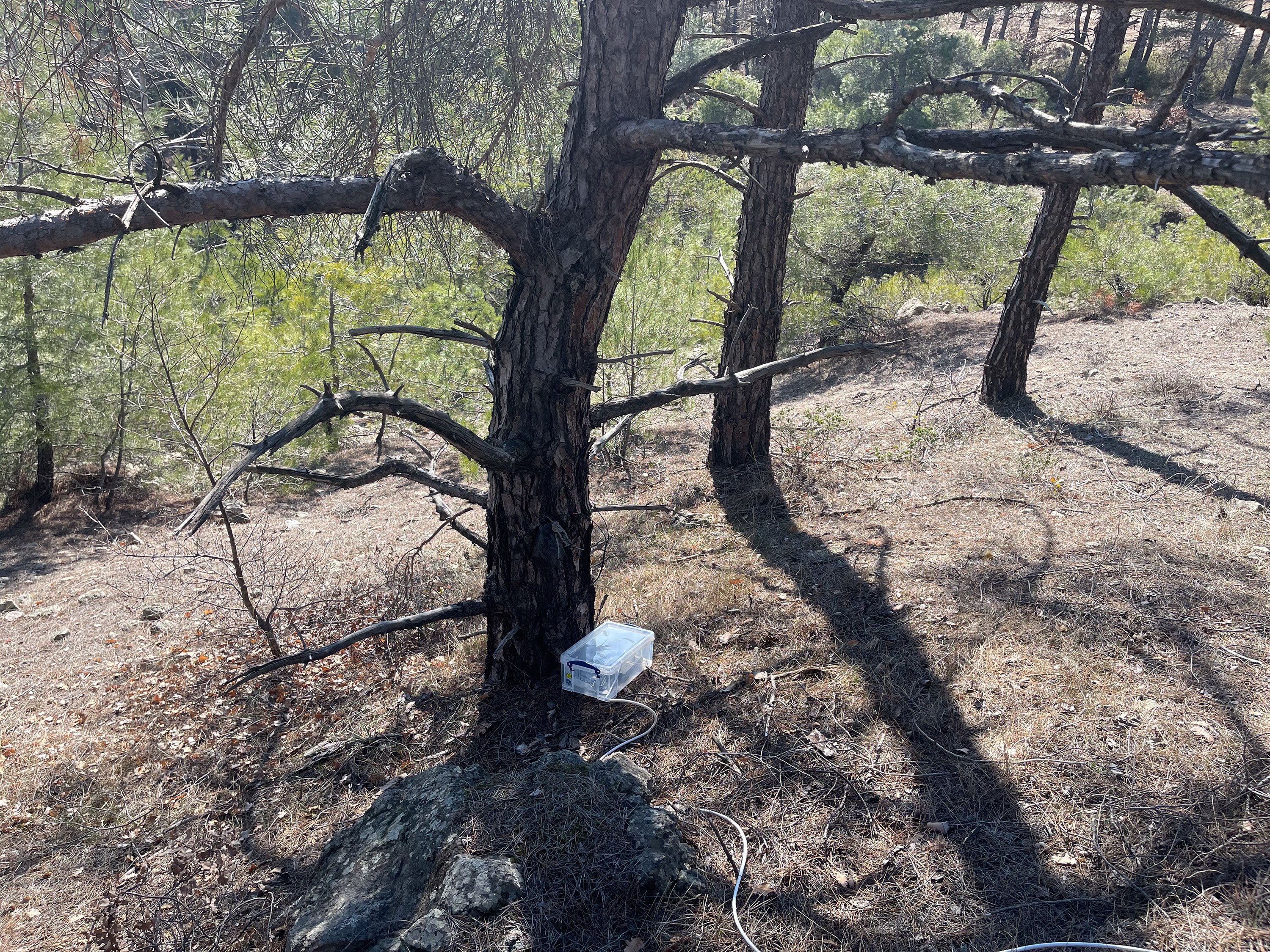
That same permission allowed me to place a live mobile microphone with the help of Giannis Tziampazis from Natural Environment & Climate Change Agency and Udo Noll from the Radio Earth group. From February to August 2025 it transmitted continuously, interrupted only by heavy rain. This made it possible to listen to the forest over an extensive period. Even when I was not physically there.
[SONIC EVENT: Tank shots, Dadia Forest, February 2025]
In February 2025, while driving with Giannis, I received a message from the Radio Earth group: the microphone five kilometers away was transmitting a sound like a gunshot. Moments later, we heard it ourselves – a low-frequency thud, muffled but powerful. The forester explained to me that these were tank shots from a military firing zone twenty kilometers away. They registered mainly between 20 and 50 Hz, arriving almost like distortion on the small speakers of a laptop.
In the emptied silence of Dadia, the sound carried far. Listening to these tank shots was only possible because of the profound silence inside the forest and the burned, naked trees.
[SOUNDSCAPE RECORDING: Mikro Dereio, Night, September 2024]
A few kilometers north, in Mikro Dereio, silence took another form.
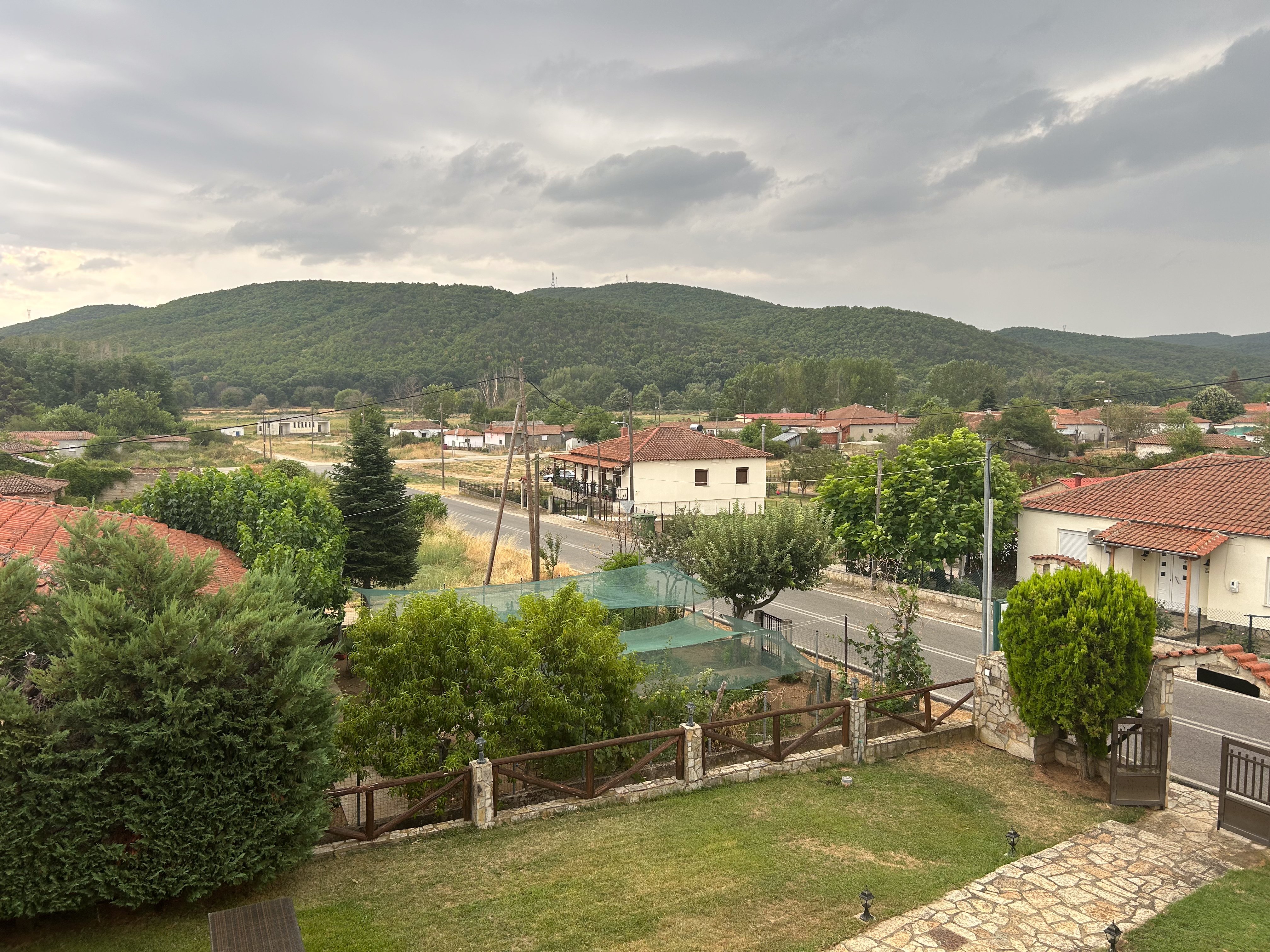
I visited the village three times between 2024 and 2025, always on my way to the Alevi village of Roussa. Mikro Dereio lies at the edge of the Dadia forest, close to the Bulgarian border. Its isolated roads, dense military infrastructure, and proximity to crossings make its name appear in many reports of pushbacks and border violence.
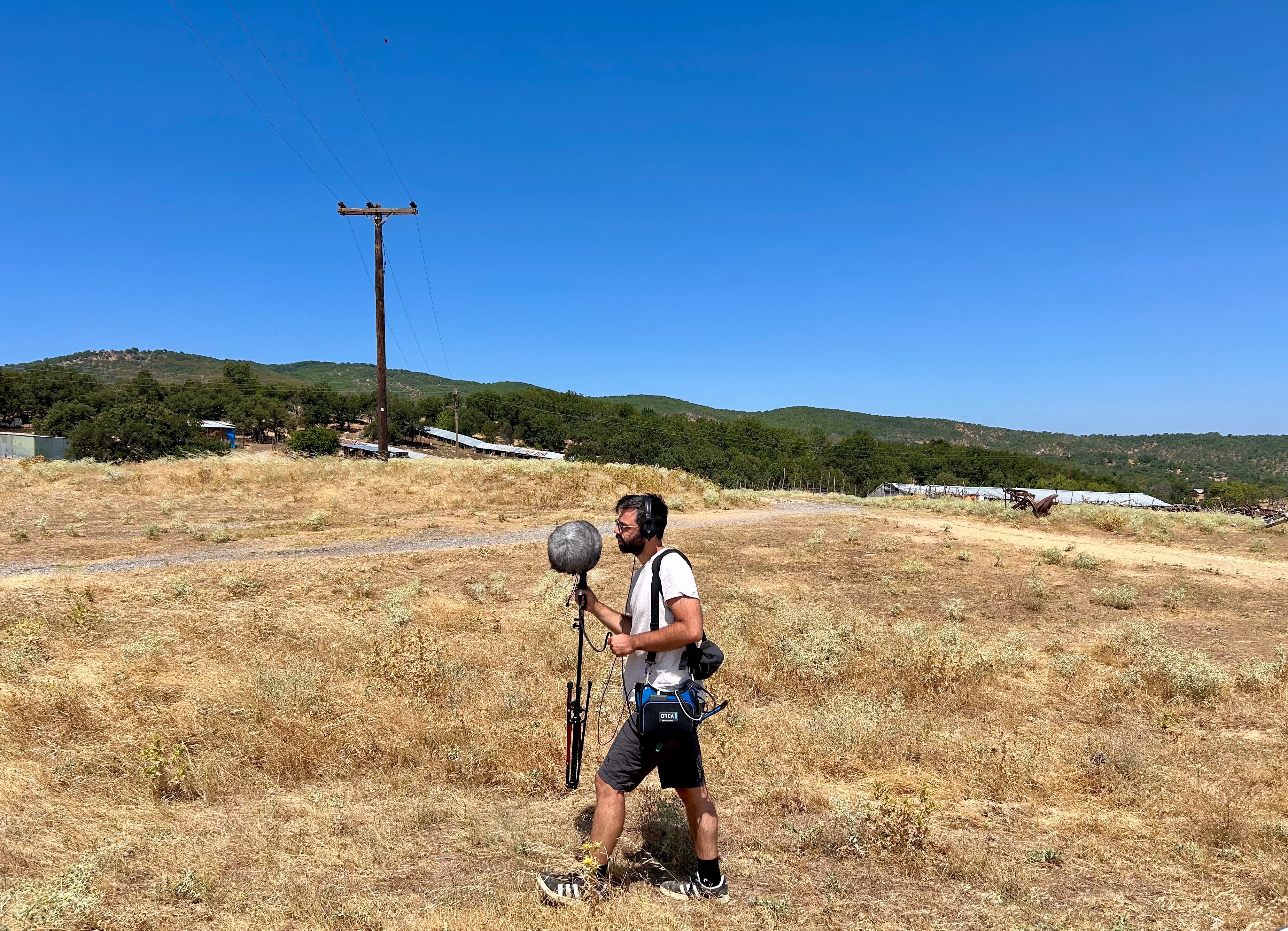
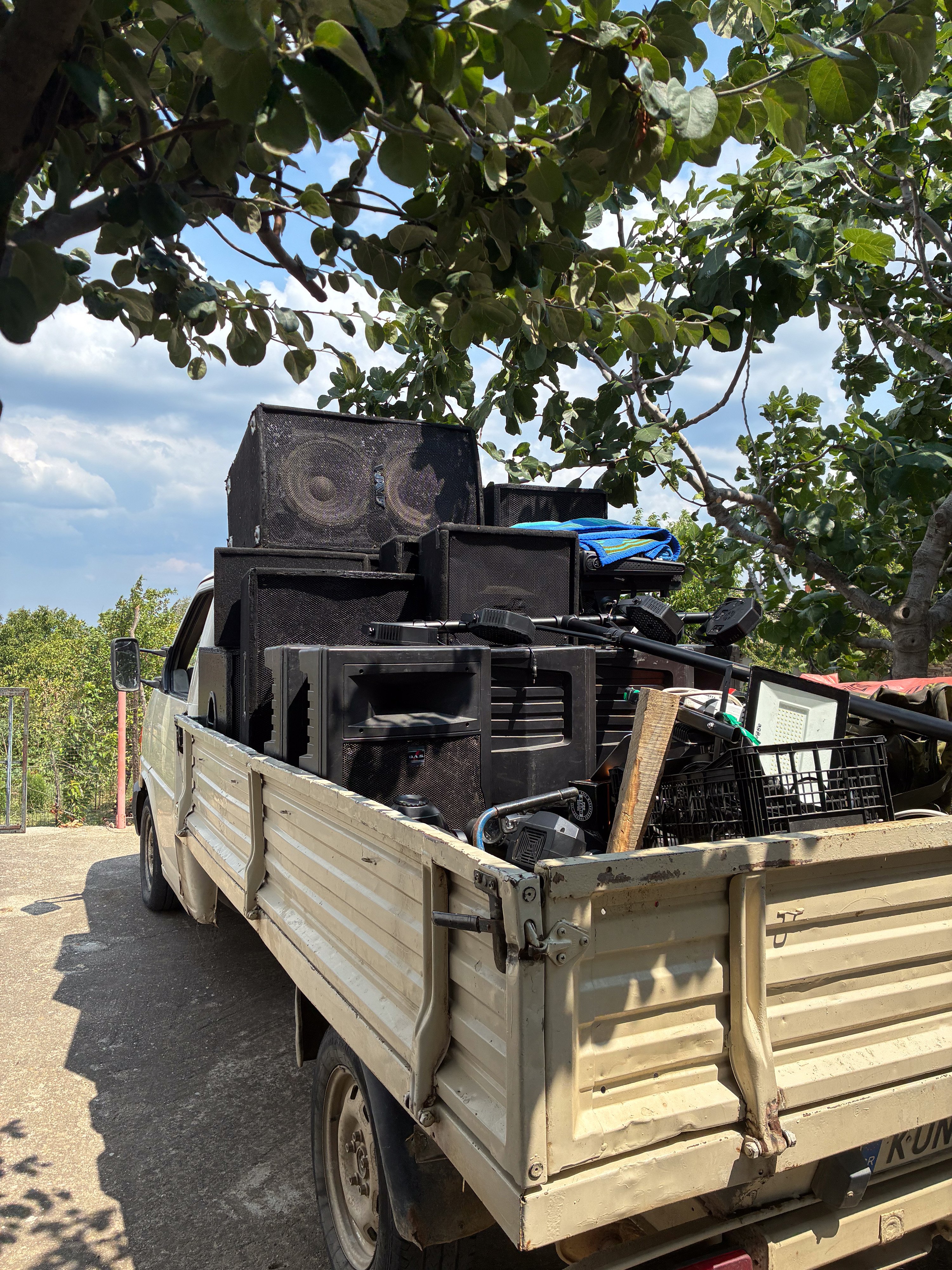
For one night in September 2024, I placed my microphones on a balcony in the center of the village, recording for almost twelve hours. The microphones were visible, drawing the attention of military and police patrols.
At first, the soundscape was what I expected: the rhythmic stridulation of crickets, the occasional drip of water from rooftops and people sleeping with open windows on a summer night.
[SOUNDSCAPE RECORDING: Drones above Mikro Dereio, Night, September 2024]
But this expectation was interrupted by a drone circling again and again every 45 minutes. The night sky dogs barking Military trucks rumbled along the roads. Dogs barked into the night – their voices often offset, as if in response to unseen crossings as a local shepherd informed me.
The night was never simply quiet. It was arrhythmic, unsettled.
Henri Lefebvre wrote that rhythms reveal both harmony and disruption. In Mikro Dereio, the silence of night was constantly broken and arrhythmic
These interruptions were not incidental; they were the sound of control and of the border expanding beyond the official lines.
[SONIC EVENT: Metal bridge at Mikro Dereio crossed by military trucks]
This was the sound of a military bridge at the entrance of the village, audible through the whole year every day and night. A metal structure that vibrates with every car passing from the south. Until 1993, this was a checkpoint of the former supervised military zone. Its resonance continues, echoing the past into the present.
Listening back to this recording, I thought of a term: Echotopia. A word game bringing together the greek word Ηχοτοπία – Soundscapes with the Ηχώ, the echoes... Echotopia as soundscapes echoing the stories of these territories.
[PAUSE]
East of here, near the minority village of Sidiro, I encountered the heaviest silence of all.
Some meters outside the village lies a site not marked on official maps.
We had to drive off road for a bit in the most careful way we could, being alerted and listening to every alternation of the soundscape.
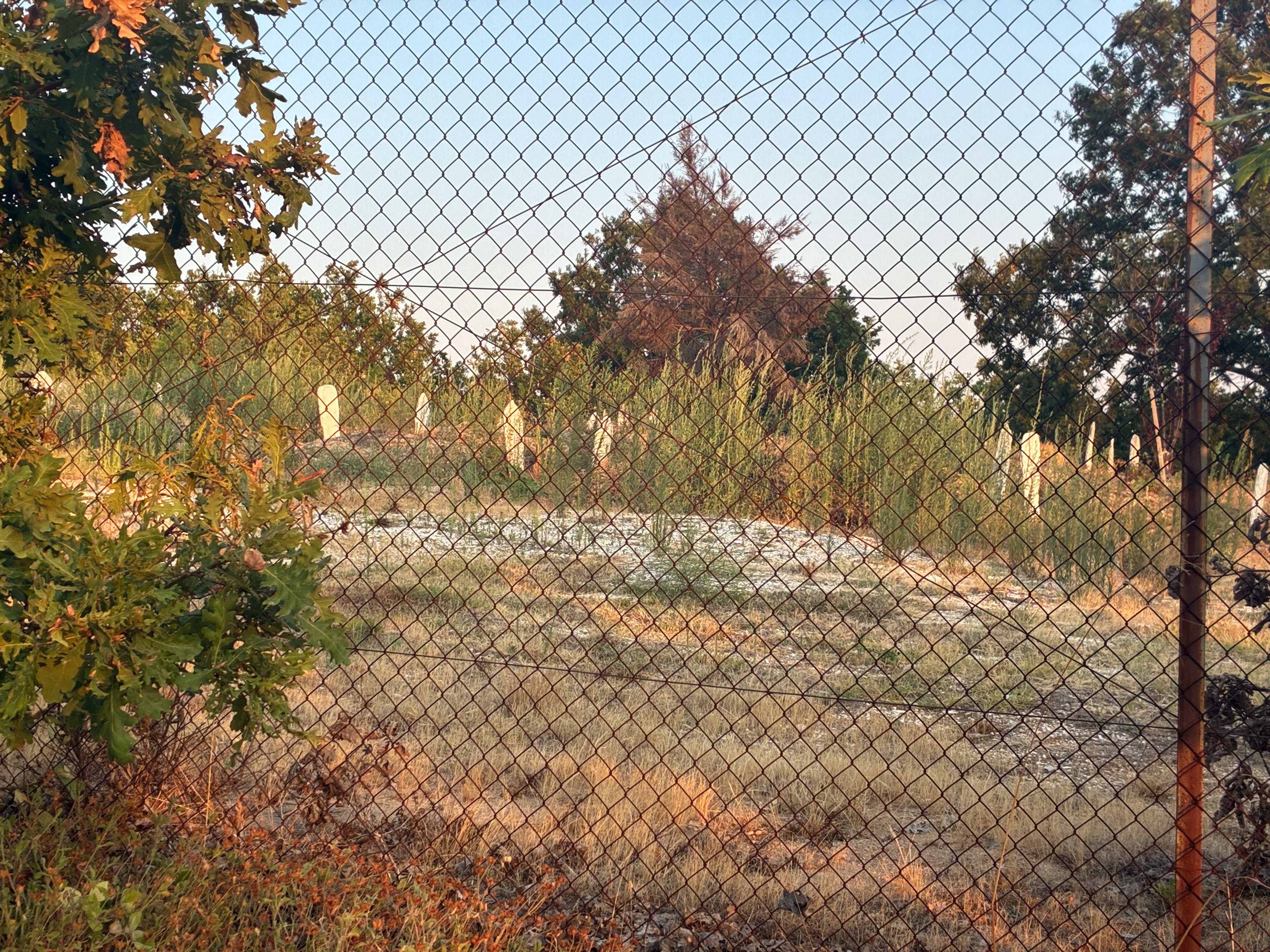
Here we encountered a fence that we decided not to cross. This is not a fence as the high tech long in kilometers fence of the river Evros, that is designed to keep the refugees away. But a barbed wire fence.
Here in this heavy silence the words of Budhaditya Chattopadhyay resonate
Whose land is this? Do I have consent to step in? To whom it may concern regarding geopolitics? (Biserna, 2022, p. 414)
Behind it lies a mass grave of refugees who died trying to cross this borderland. People whose names remain unspoken, whose presence remains unmarked.
This silence is aphonic. It is not the silence of ecology, nor the silence of arrhythmia. It is a silence of refusal. A silence of erasure.
It is heavier than the drones, heavier than the trucks, heavier than the barking dogs. It is a silence that must be listened to, louder than all the noise.
Sidiro’s silence testifies to loss, even as it resists being voiced.
[WALKING RECORDING: Sidiro, unmarked mass grave site]
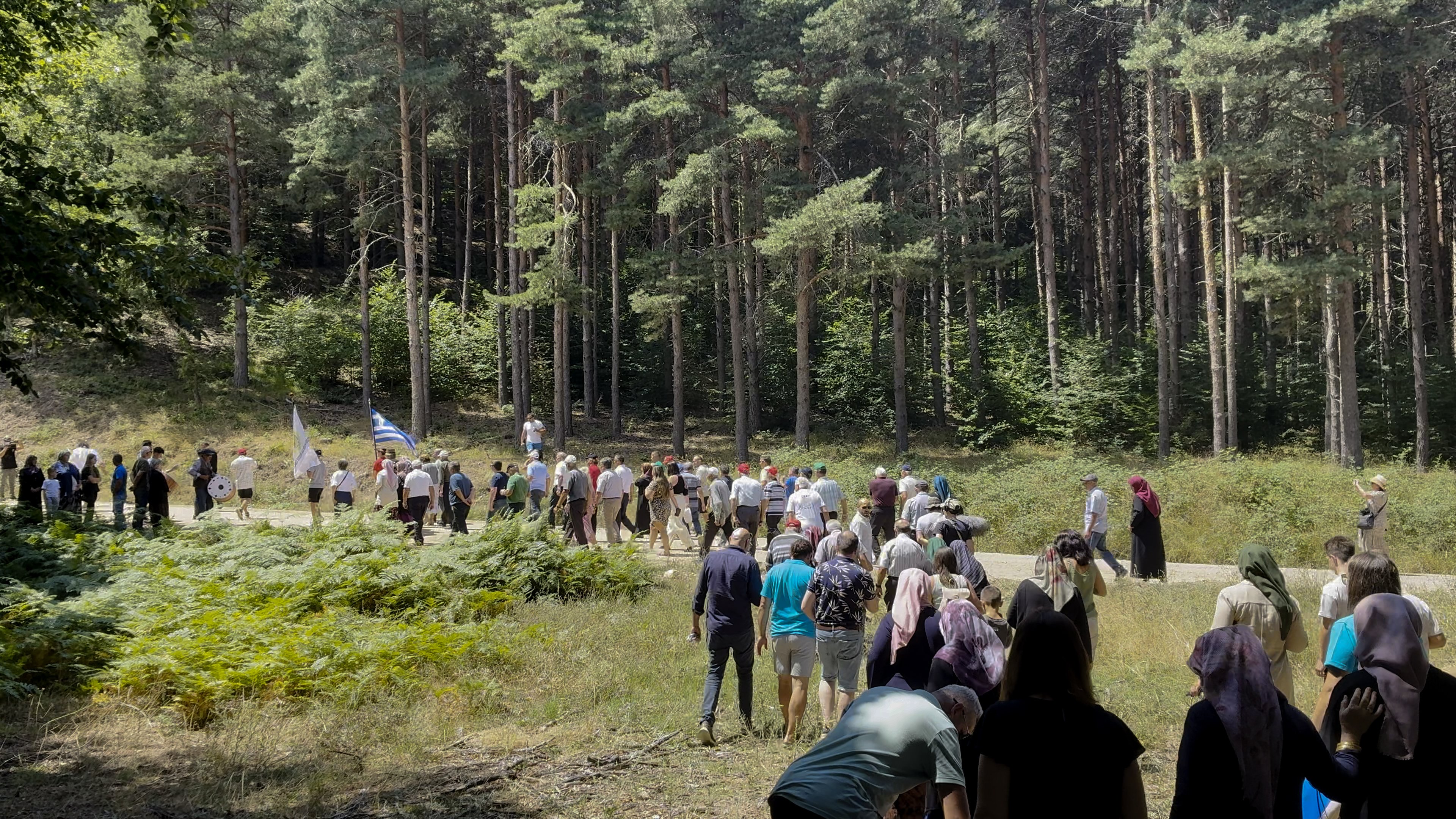
Leaving the silence of Sidiro, a bit further we found ourselves with the car on the peak of Chilia. The day after the recognition of the Alevi minority that was silenced for decades.
[WALKING RECORDING: Alevi procession to Mount Chilia, day after their recognition as independent minority]
Traversing the border through listening is to move across silences, noises, and rhythms that are never neutral. Each place offers a fragment: the drones circling above Mikro Dereio, the low frequencies of tank shots rumbling through Dadia’s forest, the aphonic silence after wildfires, the silence of the mass grave in Sidiro. None of these stand alone; they overlap, interrupt, and resist one another.
Lefebvre described everyday life as polyrhythmic – a texture of rhythms that sometimes align and sometimes collide. In the borderland, rhythm often collapses into arrhythmia. Listening here means learning to hear those arrhythmias, not smoothing them over, but acknowledging their presence as part of the border’s reality.
Silence is never just the absence of sound. It is memory, refusal, or enforcement. The aphonic silences of Dadia and Sidiro remind me that not everything can be made audible. Some silences mark loss, some mark protection, some mark violence that cannot be easily voiced.
This is an Open Access article, distributed under the terms of the Creative Commons Attribution licence CC BY-NC-SA 4.0
Biserna, E. (2022) Going Out: Walking, Listening, Soundmaking. Brussels: umland editions.
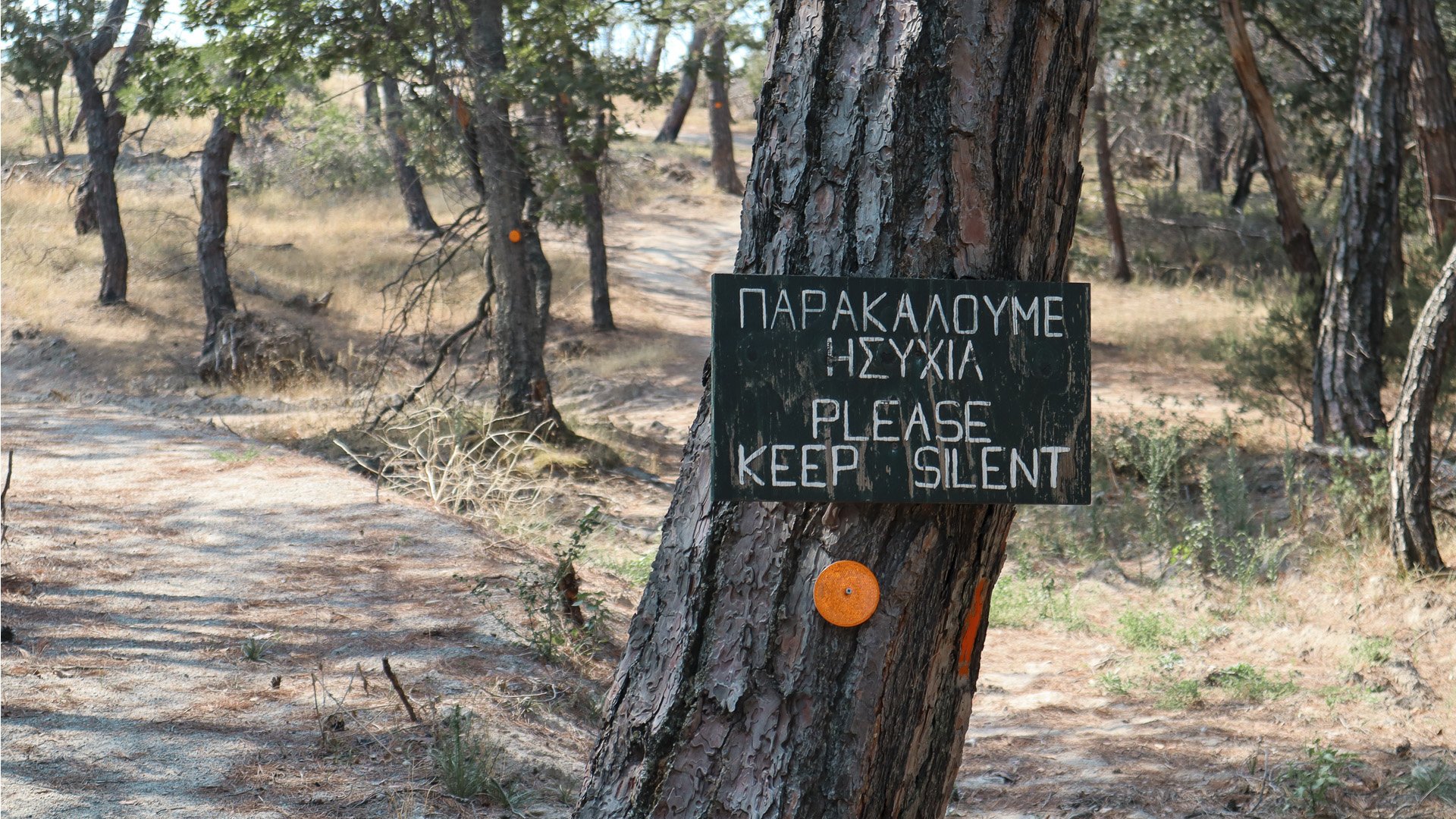
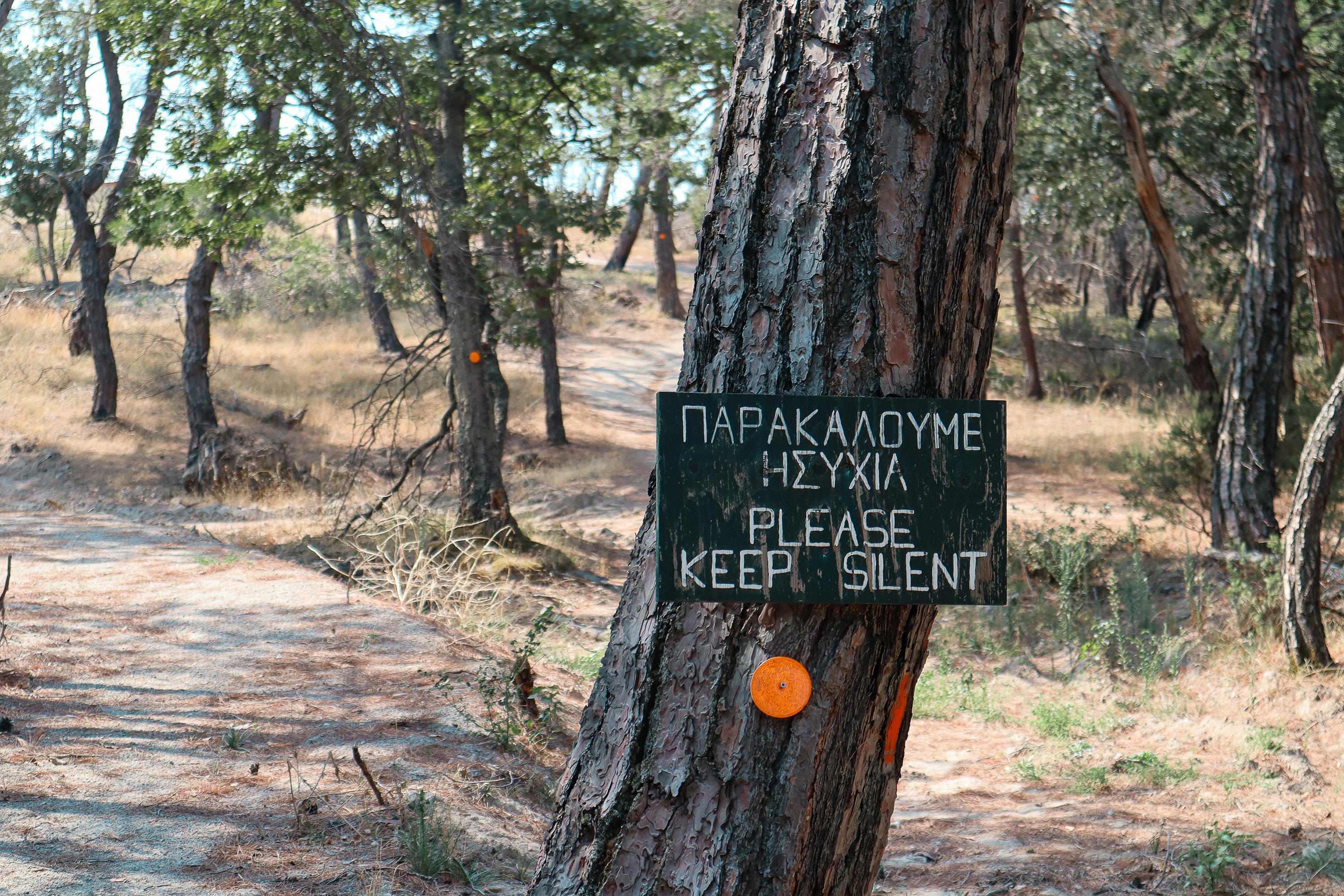
A ‘Keep Silent’ sign on the path to the bird observatory in the Dadia Forest, September 2024
Photo credit: Lefteris Krysalis
This self-reflective audio paper investigates the politics of listening in the borderlands of Western Thrace, Greece. Introducing the notion of ‘aphonic borderscapes’, it examines how listening, soundwalking, and long-durational field recording can attune us to forms of silence shaped by ecological destruction, militarization, and erasure. The work moves through three sites: the ‘emptied’ ecological silence of the burned Dadia Forest; the ‘arrhythmic’ militarized quiet of Mikro Dereio; and the ‘aphonic’ silence of unmarked loss outside Sidiro. By attending to these sonic territories, the essay explores how silence and arrhythmia operate as political forces. It asks how an artist-listener may ‘lend an ear’ to narratives rendered inaudible, proposing a methodology of situated listening that recognizes the interdependence between recordist, landscape, and the echoes of those who traverse these contested terrains.
Keywords: politics of listening, aphonic borderscapes, Western Thrace, border soundscapes, Dadia forest, Evros, Alevi minority, migration and surveillance, sonic methodology, ecological silence, echotopia, rhythmanalysis, soundscapes
Born in Athens, Lefteris Krysalis lives in Weimar. He completed his BA in Art History and Theory at the Athens School of Fine Arts and his MFA in Media Art and Design at the Bauhaus University Weimar, where he studied at the Experimental Radio and Studio for Electroacoustic Music. From 2018 to 2020, he held a DAAD scholarship. From 2020 to 2022 he was the coordinator of the Radio Art Residency Weimar. He is currently Artistic Associate at the Experimental Radio Chair and a PhD candidate at the Bauhaus University Weimar. His research and artistic practice focus on soundscapes and the politics of listening.
Krysalis, L. (2025) ‘Listening to Aphonic Borderscapes in Western Thrace: A Self Reflective Audio Essay’, Witnessing, 1. Available at: https://doi.org/10.26238/witnessing.2025.01.10