Witnessing

A Journal of Critical Humanities and Socially Engaged Arts

General
  • About
  • Contact
  • Submit
  • Issues
  • Issue 01
  • ISSN 3057-5605
    DOI 10.26238/witnessing.2025

    (Syn)kinetic Listening[s]. Narrative, Sensory, & Affective Flows in ‘Difficult’ Spaces


    1| Re-/(Un)-Framing the Frame


    This paper draws on aspects of my doctoral research conducted in Amerikis Square, between 2019 and 2021, in which I attempted to approach the ways through which my thirteen interlocutors –residents of the area at the time– experienced the space they resided focusing on their embodied and kinetic relationalities. During my fieldwork, I explored the multiple and multifaceted modes through which my interlocutors engaged with this particular space at that specific moment, attending to questions of sensoriality, emotionality and (im)mobility, and to how these were expressed through and as voice, sound, silence, vibration, movement, pause.

    Image opens in a full-page gallery when clicked.
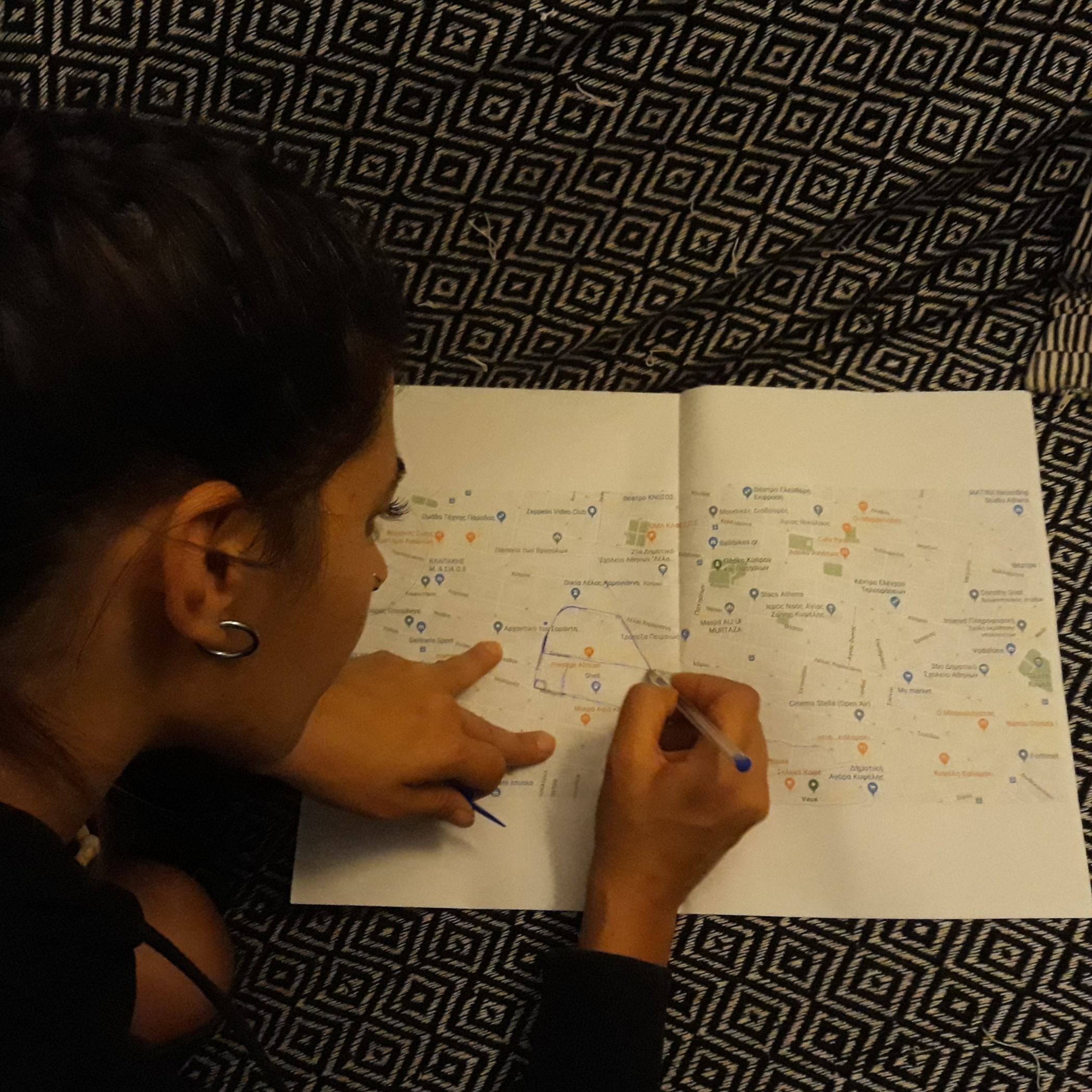
    Auto-biographical mapping as research-creative spatial practices

    The sonic material that my interlocutors often produced and shared with me, generated precisely such possibilities: invitations for me to sense, to understand, and to (partly) partake in their movements-in-thought / thoughts-in-movement. The following recording was sent to me by my interlocutor Gelina. It is an intimate voice-and-rhythm improvisation with the sound of a washing machine in her house, which she titled “washing machine and me.”

    Image placeholder
    09.05.2024
    Sonic improvisation | Gelina and the washing machine (and vice versa)
    Gelina

    ..................

    Returning to my methodological approach, in a subsequent stage –though one organically intertwined with the previous– the america² project brought part of this sonic research material back into the same space in the form of a locative, interactive audio walk. Designed and implemented again through ‘research-creation’ processes, america² functioned as a critical mode of analysis, reflection, and the production of new theory and practice –reconstituting, in new performative ways, the earlier stages of my doctoral research.

    The geographic area mapped in america² (screenshot from Echoes).

    ..............

    On the one hand, Grace seeks to become less available, less interruptible while walking in public space. On the other, she asks for her voice to be heard through the intimate sound file(s) she shares with me and, potentially, with my other interlocutors. One of the practices I adopted during the narratives in-motion methodology was to share –with their permission– sonic and other material from one interlocutor to another, as well as with the potential ‘walkers’ of america² (again, my interlocutors knew from the beginning that part of the sonic material shared with me would become part of an open, published audio-walking project in the neighborhood). She, thus, finds herself into this “double” position –one that strongly connects with Athanasiou’s words above– between a choice to become silent, to “disappear” from public space through the various ‘techniques for invention’ (Manning, 2009, p. 10) she adopts, and a choice to be heard through other kind of resonances. In turn, I find myself staying with what is partial, what is withheld but also offered to me, ‘staying with the trouble’ (Haraway, 2016) of the limits of listening, attending to my own listen-ability as I witness her and the other womens’ voice(s), silence(s), (im)mobilities, and situated sensorialities.

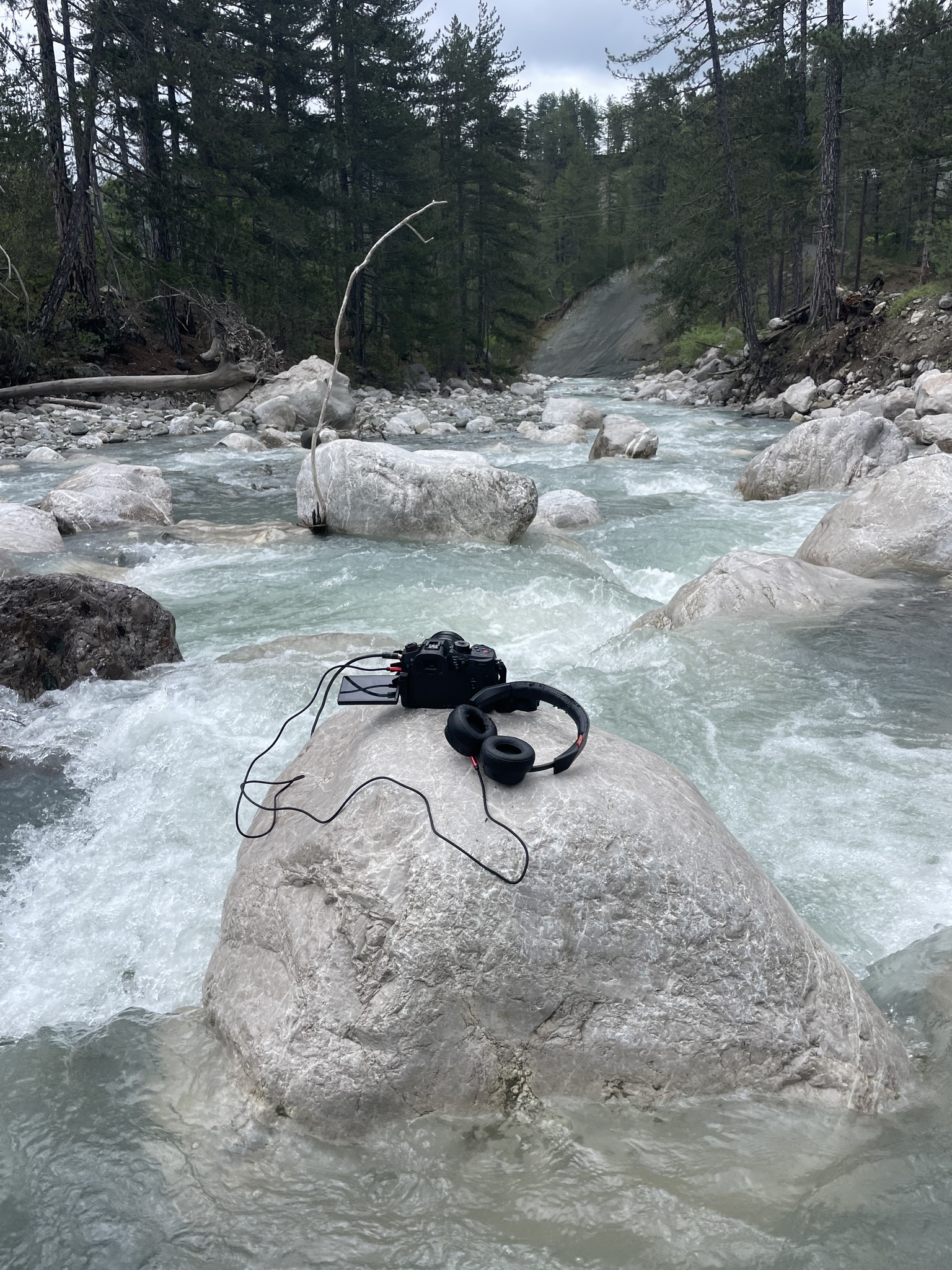
    Walking-with headphones as a technique of creating safe spaces

    ...................

    Kinetic listening in america² seems to be produced through an affective sense of co-presence, an experience of walking-with those one listens to: hearing their footsteps (or imagining them?), sensing the ways their bodies move through space, the events that shape this movement, the choices they makechoose not to make—or choose not to make. It involves attuning to the multiple ways in which others inhabit and negotiate this same –but always situatedly different– space, taking the form of a temporary assemblage of bodies, sounds, and trajectories.

    Listening attunements | walking-with america²

    The artist Teri Rueb, speaking about her mobile auditory works, ‘describes (and experiments with) how technologies, bodies, and subjectivities are inextricably “entangled” in everyday experience, and how mobile technologies further intensify these entanglements’ (Rueb, 2014, as cited in Sheller, 2015, p. 136). If we consider that sound (and speech-as-sound) establishes and enacts a personal presence that occurs ‘here and in this moment’ (Ong, 1967, as cited in Cavarero, 2005, p. 173), we can then approach the sound-based, situated experience of america² as a potential field of co-presence, among the subjects involved in it. Listening in/through america² was often produced as resonance and co-movement. Viewed from another perspective, this co-movement extends into syn-kinesis as another form of affectivity (Hamilakis, 2015, p. 150), moving beyond the limits of subjective emotional state embedded in my interlocutors’ narratives, and ‘found in those intensities that pass from body to body’ (Seigworth & Gregg, 2010, p. 1); as affect[s]-in-motion (Gatou, 2023).

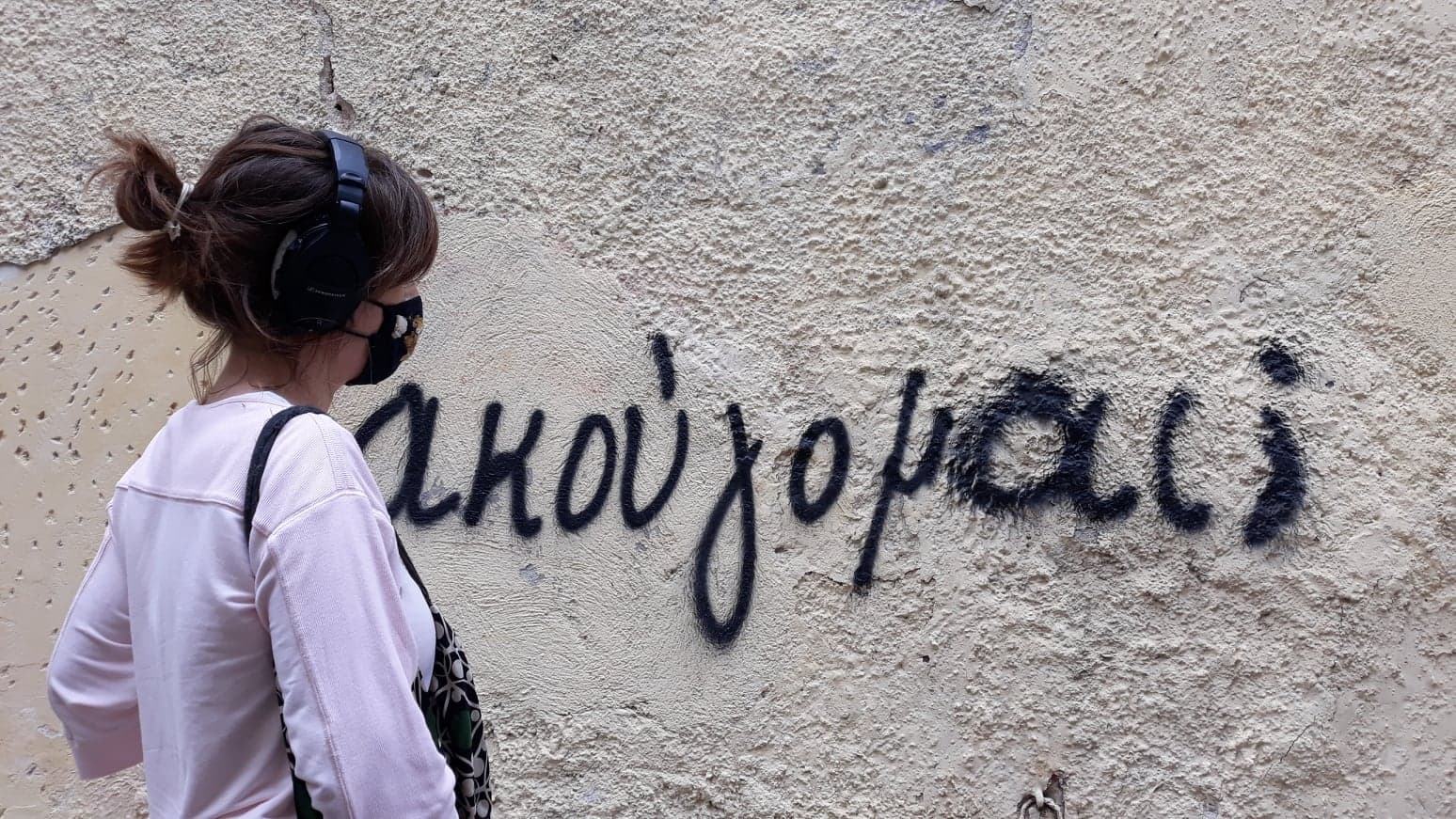
    Walking with america² in front of a wall that asks, ‘am I heard?’

    .....

    Listening through america² is produced across a meshwork of bodies that resonate with one another. And it is this ‘acoustic relationality between resonating subjects’ that establishes ‘an important political condition’ (Athanasiou, 2016, p. 120). ‘A geography of sound has no maps; it produces no cartography,’ writes Voegelin (2019, p. 75). Similarly, the geographies of encounters taking place through america² remain untraceable and open-ended. In this sense, the locativity of america² can be understood as a political space; what Cavarero calls a ‘political scene of co-appearance’ (2000, p. 57), or what Massey calls a space of ‘throwntogetherness’ (2008, pp. 149-162).

    Locative encounters | resonant bodies – resonant listening(s)

    ............

    ‘It is always a risk to let someone in,’ writes Berlant (2006, p. 26). Yet it is precisely this risk that holds the potential for co-presence to produce affective spaces of disruptive listening. This text constitutes an un-/(re)framing effort toward the stories, sensorialities, and embodiments that my interlocutors entrusted to me –Despoina, Gelling, Grace, Konstantza, Maria, Peggy, Stella, Souzana. Even if I did not refer explicitly to all of them above, they equally resonate within these lines, and beyond them.


    This is an Open Access article, distributed under the terms of the Creative Commons Attribution licence CC BY-NC-SA 4.0


    Acknowledgments

    This article has received funding from the European Research Council (ERC) under the European Union’s Horizon 2020 research and innovation programme (grant agreement no. 101002720 – MUTE).


    Endnotes

    References

    Cover Image

    xxx
    Photo credit: xxx


    Abstract

    This article explores listening as a mobile, relational, and affective practice emerging through a research-creation conducted in Amerikis Square between 2019 and 2021. Drawing on my doctoral research, the paper examines how embodied experiences of space unfold through practices of movement, voice, sound, and silence. Focusing particularly on material related to eight female interlocutors, the article approaches listening as a situated feminist practice shaped by positionality, vulnerability, and response-ability.


    The analysis develops through two interrelated processes. The first concerns the methodology
    narratives in-motion, a multimodal, sensory- and walking-based framework designed to explore participants’ spatial experiences through embodied, sensory and sonic practices. The second examines the locative audio walk america², which re-situates part of the research material back into the neighborhood as an interactive listening experience.
    Across these two organically interweaved stages,
    listening emerges as a (syn)kinetic practice produced through movement, relational encounters, and affective attunements between bodies-in-space. Rather than focusing on geographic precision in relation to the use of locative media, the analysis foregrounds the in-between spaces where narrative, sensory, and affective flows are produced and circulate.


    By attending to these
    listening practices, the article reflects on the politics of audibility in public space and within the research process: which voices become heard or remain unheard, how listening unfolds through embodied mobility and immobility, and how locative sonic practices may open new possibilities for resonance, co-presence, and spatial relationality.

    Keywords: (syn)kinetic listening, narratives in-motion, affect in-motion, audibility, listening, response-ability, (im)mobility, Amerikis Square
    About the Author

    Ismini Gatou is a researcher, transdisciplinary artist, and educator whose work examines spatiality, relationality, and (im)mobility in public space. Drawing on media studies, anthropology, feminist theory, posthuman philosophy, and sound studies, and working through research-creation methodologies, she explores the intersections of sensoriality, technological mediation and spatial experience. Her artistic practice engages diverse media and forms, including interactive mapping, video, photography field/voice recordings, soundscape composition, walking projects, and locative media arts –often developed through site-specific, participatory and public processes. She holds a PhD in Cultural Technology and Communication from the University of the Aegean (2023). Her doctoral thesis, ‘Narratives and Affects in Motion: A Research-Creation on Spatial Experience through the Use of Mobile Digital Media’, was funded by the A.G. Leventis Foundation (2016–2017) and the State Scholarships Foundation (IKY) (2018–2022). In 2022–23, she received the ARTWORKS Award in Visual Arts and was a Stavros Niarchos Foundation Artist Fellow. She is currently an Academic Fellow at the Department of Culture, Creative Media and Industries, University of Thessaly.


    Citation

    Gatou, I. (2026) ‘(Syn)kinetic Listening[s]. Narrative, Sensory, & Affective Flows in ‘Difficult’ Spaces’, Witnessing, 2. Available at: https://doi.org/


    This article is part of:

    Issue: 02

    Politics of Listening and the Ethics of Witnessing

    December 2026

    co-edited by Athena Athanasiou, Nelli Kambouri and Anna Papaeti

    ● Editorial
    ● Short Essays
    ● Audio essays